![Perform[cb] Logo](https://www.performcb.com/wp-content/themes/performcb/assets/images/pcb_logo_full.svg)
![Perform[cb] Logo](https://www.performcb.com/wp-content/themes/performcb/assets/images/pcb_logo_mark.svg)


![Perform[cb] Logo](https://www.performcb.com/wp-content/themes/performcb/assets/images/logo.svg)
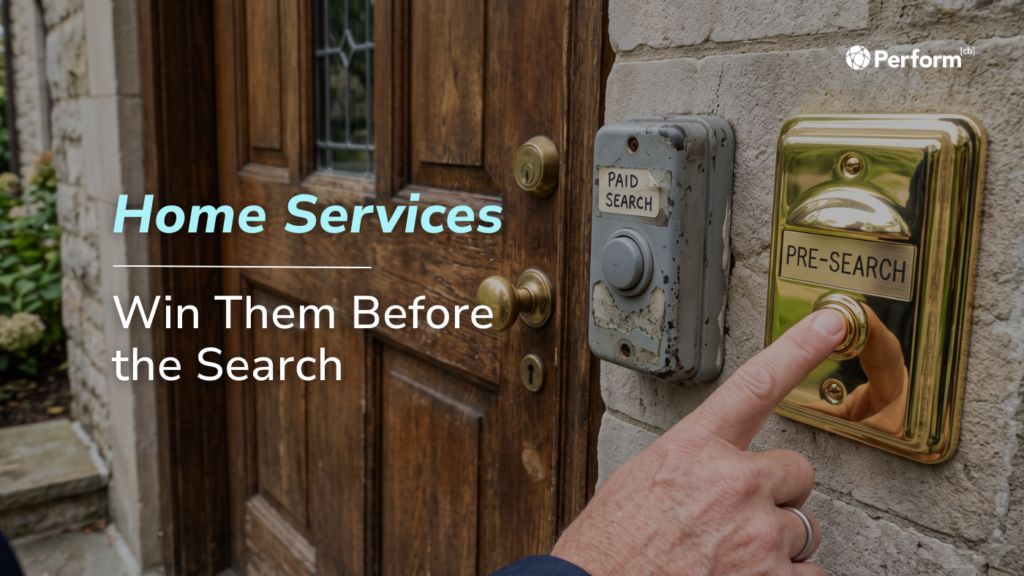
Table of Contents
Home services marketers do not need another lecture on paid search.
You know why it works. When a homeowner searches “roof repair near me,” “new HVAC system cost,” or “solar installation quote,” intent is already on the table.
But, by the time a homeowner hits Google, the auction is packed, the comparison set is crowded, and the brand with the cleanest economics is not always the brand that wins. According to LocaliQ’s 2025 home services search advertising benchmarks, the average home services search ad Cost Per Click (CPC) is $7.85, with an average Cost Per Lead (CPL) of $90.92.
That is the average, not the pain ceiling.
If your acquisition plan starts when the homeowner searches, you are showing up after the problem has already become urgent.
The brands building stronger CAC efficiency are getting in earlier. They are reaching homeowners while the need is forming, while research is happening, and while competitors are still waiting for a keyword to fire.
Table of Contents
- Quick Answer
- The Real Problem with Home Services Paid Search
- What Pre-Search Homeowner Acquisition Actually Means
- How Native Advertising and Pre-Search Channels Create Demand
- Which Pre-Search Channels Actually Deserve Budget?
- Decision Verdict
- Perform[cb] Proof Point: Home Improvement Growth Beyond Existing Channels
- How to Measure Incremental Demand Without Fooling Yourself
- Common Scenarios Where Pre-Search Acquisition Works Best
- When Paid Search Should Still Lead
- FAQ: Home Services Marketing Before Paid Search
- Planning Frameworks for Pre-Search Home Services Campaigns
Quick Answer
Home services marketing before paid search means reaching homeowners before they actively search Google for a provider. Instead of only bidding on urgent bottom-funnel demand, brands use native advertising, contextual placements, rewarded in-app traffic, keyword conquesting, card-linked offers, and verified engagement campaigns to create demand earlier and reduce CAC pressure.
The Real Problem with Home Services Paid Search
Paid search is not broken.
It is just expensive to treat it like your only acquisition engine.
Search works best when a homeowner has already named the problem. That makes it valuable, but it also makes it obvious. Every serious HVAC, roofing, solar, plumbing, pest control, and home improvement brand wants that same click.
The result is a squeeze every home services marketer recognizes. More budget flows into the same bottom-funnel terms. CPCs climb as local competition intensifies. Lead quality fractures by keyword, market, and provider availability. CAC creeps up while volume becomes harder to scale – and the dashboard still looks busy enough to feel like progress.
This is where many brands make the wrong move. They keep raising bids because the channel still converts.
A marketer might start the year with a $110 CPL target, watch core terms move closer to $150 by Q3, and still miss booked-job goals because the added spend is buying more competition, not more demand.
That is not a search problem. That is a timing problem.
The Search Trap
| What Marketers See | What Is Usually Happening |
| Search converts well | The homeowner is already deep in the buying journey |
| More spend creates more leads | Marginal leads often cost more than core volume |
| Competitors dominate impression share | Everyone is chasing the same urgent demand |
| CAC rises despite optimization | The brand is buying late-stage intent instead of building earlier intent |
The fix is not abandoning search. The fix is giving search more demand to capture.
For a broader view of how performance-based acquisition supports channels already working, see Perform[cb]‘s CPA marketing guide for brands.
What Pre-Search Homeowner Acquisition Actually Means
Pre-search homeowner acquisition is the strategy of reaching homeowners before they search Google for a specific home services provider.
The audience is not cold. It is early.
Homeowners research before they search. They read about high energy bills before evaluating solar, compare HVAC maintenance tips before a system fails, follow storm coverage before checking roof damage, and research renovation financing before choosing a contractor.
That window is where preferences start forming. Pre-search homeowner acquisition gives brands a chance to influence the decision earlier, when attention is less expensive and competition is less direct.
This is not upper-funnel theater.
Done well, pre-search acquisition is measured against customer outcomes, not vanity metrics.
Most home services acquisition plans are organized around channel mix.
That misses the better question.
The better question is: when does the homeowner become reachable before they become expensive?
The answer depends on the category.
In HVAC, the signal is content about utility bills, old units, or seasonal maintenance. In roofing, it is weather coverage, hail alerts, insurance questions, or post-storm cleanup content. In solar, it is energy savings, tax credits, and household electrification.
Angi’s 2024 State of Home Spending Report found that total home project spending declined 12% in 2024, yet 93% of homeowners still planned projects in 2025.
Homeowners are still planning work, but they are more selective about where money goes.
Selective homeowners research longer.
That creates more chances to influence them before they click a search ad.
What Changes When You Reach Homeowners Earlier?
| Late-Stage Search Only | Pre-Search Plus Search |
| You compete when urgency is highest | You build familiarity before urgency peaks |
| You pay for active comparison | You shape the comparison set |
| You rely on available search volume | You create more future demand |
| You optimize keywords | You optimize timing, audience, and outcome quality |
| You measure last-click wins | You measure net-new customer lift |
The marketer who wins is not always the one with the highest bid.
It is often the one the homeowner recognizes before they ever open the search tab.
How Native Advertising and Pre-Search Channels Create Demand
Native advertising works for home services because it reaches homeowners while they are consuming related content, not while they are actively shopping providers.
That difference is the whole point.
A roofing brand does not need to wait for “roof replacement near me.” It can reach homeowners reading storm damage explainers, hail preparedness content, or insurance claim guidance.
An HVAC brand does not need to wait for “AC repair emergency.” It can reach homeowners reading about high electric bills, system maintenance, or indoor air quality.
Native advertising home services campaigns work best when the message matches the moment.
Not every homeowner is ready for a quote.
Many are ready for a reason to pay attention.
Native Advertising for Home Services: Where It Fits
| Home Services Category | Pre-Search Content Moment | Better Message Angle | Outcome to Measure |
| HVAC | Rising utility bills, seasonal maintenance, old systems | “Know when repair stops making financial sense” | Qualified appointment requests |
| Roofing | Storm coverage, hail alerts, insurance questions | “Check for damage before small issues get expensive” | Inspection requests |
| Solar | Energy bills, tax incentives, grid costs | “See if your home qualifies for savings” | Verified quote starts |
| Pest Control | Seasonal pest activity, local outbreaks | “Stop the issue before it spreads” | New customer bookings |
| Home Improvement | Financing, renovation planning, project costs | “Plan the project before prices surprise you” | Consultation requests |
For a deeper look at acquisition sources that consistently produce quality leads, read Perform[cb]‘s guide to where top home services brands find their best leads.
Native is not a cheaper version of search.
Native is how you get into the decision earlier.
Which Pre-Search Channels Actually Deserve Budget?
Not every channel deserves a seat in the plan.
The right channel depends on the homeowner’s decision stage, the service category, and how tightly the campaign can connect engagement to downstream outcomes.
Most acquisition platforms stop at the click, lead, or form-fill layer. They can tell you what converted, but not which environments, partners, and engagement signals consistently produce customers worth keeping.
Perform[cb]‘s Outcome Engine is built to close that gap. It evaluates source-level performance, partner quality, conversion validation, fraud signals, payout rules, and downstream customer outcomes. Then it automatically reallocates spend toward partners and placements, producing approved outcomes while suppressing low-quality traffic before it distorts campaign data.
The goal is not to rip budget out of search.
The goal is to create more customers your current channels can help close.
Channel Fit by Home Services Use Case
| Channel | Where It Works Best | Watchout | Strongest Outcome Signal |
| Native Advertising | HVAC, roofing, solar, pest control, renovation planning | Weak creative turns it into low-intent traffic | Quote starts, appointments, booked consultations |
| Contextual Placements | Weather, energy, financing, maintenance, local project content | Context must be specific, not broadly “home” | Lead quality by content category |
| Rewarded In-App Traffic | Offer discovery, eligibility checks, consideration-stage engagement | Incentive must not replace genuine intent | Verified engagement tied to down-funnel events |
| Keyword Conquesting | Adjacent solution research and competitor comparison moments | Needs careful compliance and message discipline | Conversion assist rate and new customer rate |
| Card-Linked Offers | Local services, seasonal promotions, service-triggered spending | Best for clear consumer actions, not complex education | Redeemed offers and customer matchback |
| CPE-Optimized Campaigns | Multi-step funnels where engagement predicts conversion quality | Optimize to meaningful events, not cheap actions | Verified down-funnel event completion |
The mistake is treating these channels like a menu.
They are not equal. They are levers.
An HVAC brand with high seasonal urgency should prioritize contextual placements and native content tied to energy costs. A solar brand with a longer research cycle should test native education, keyword conquesting, and CPE campaigns tied to eligibility checks. A regional roofing brand after storm activity should lean into contextual placements first, then use search to capture the surge.
That is the performance marketer’s edge: matching channel to timing instead of matching budget to habit.
Decision Verdict
Paid search is the better choice when you need to capture homeowners who are already searching.
Pre-search homeowner acquisition is the better choice when you need to create more demand, reduce dependence on crowded auctions, and improve blended CAC over time.
Most growth teams need both.
| Decision Category | Paid Search Wins When… | Pre-Search Wins When… | Best Overall Choice |
| Immediate lead volume | You need leads this week | You can build future demand | Paid Search |
| CAC efficiency | CPCs are stable and quality is strong | Search CAC is rising or plateauing | Pre-Search |
| Market expansion | Existing search volume is enough | Search volume caps growth | Pre-Search |
| Brand familiarity | Homeowners already know you | You need earlier consideration | Pre-Search |
| Measurement control | Last-click reporting is the only available view | You can track lift, assists, and verified outcomes | Pre-Search |
| Sustainable growth | Search still scales efficiently | You want more customers without overpaying for every click | Combined Approach |
The strongest move is not choosing a favorite channel.
It is building a system where paid search captures demand and pre-search acquisition creates more of it. Perform[cb]’s Outcome Engine is designed around that idea: measure the customer outcome, validate the traffic source, and optimize toward the partners that create customers instead of clicks.
Perform[cb] Proof Point: Home Improvement Growth Beyond Existing Channels
A home improvement marketer specializing in homeowner lead generation for contractor and home improvement service projects needed more volume without letting lead quality collapse. Their existing acquisition program had room to grow, but a flat payout structure made it harder to separate high-performing sources from traffic that looked efficient on the surface and underperformed later.
Perform[cb] expanded the program beyond its existing acquisition mix by introducing and testing new traffic channels throughout the funnel. PerformSense AI analyzed historical performance data to identify the channels most likely to produce qualified prospects, then the Outcome Engine optimized spend in real time toward sources producing stronger conversion behavior. Lead sources were evaluated against qualification and conversion data, not just front-end form volume, so the team could scale the partners driving meaningful outcomes and pull back on weaker traffic before it diluted performance.
Over four years, the home services client increased conversions by 41%. The program also produced a 1,917% increase in quality leads, but the conversion lift is the number that matters most: more of the acquired demand turned into a downstream action the business could use.

The lesson is not “add more traffic.”
The lesson is that the right payout structure, partner mix, and quality controls can unlock scale that a one-channel acquisition plan leaves on the table.
This is the home services case for a broader truth: your existing channels are only part of the picture.
How to Measure Incremental Demand Without Fooling Yourself
The hard question is not whether pre-search acquisition drove leads.
The hard question is whether those leads were new.
Performance marketers should be allergic to channels that take credit for demand search would have captured anyway. That is how budgets get bloated and dashboards get polite.
Measure pre-search acquisition by how much net-new customer volume it creates at an acceptable CAC.
Incrementality Measurement Framework
| Measurement Method | What It Tells You | When to Use It |
| Geo Holdout Test | Whether exposed markets outperform non-exposed markets | Regional home services campaigns |
| Conversion Path Analysis | Whether pre-search touchpoints influence later search or direct conversions | Multi-channel acquisition programs |
| New vs Returning Lead Analysis | Whether campaigns attract fresh prospects | Brands with strong CRM history |
| Assisted Conversion Review | Whether early engagement contributes to booked outcomes | Native and contextual campaigns |
| CAC Cohort Comparison | Whether blended acquisition cost improves over time | Budget reallocation decisions |
| Down-Funnel Event Tracking | Whether leads become appointments, quotes, installs, or customers | CPE and pay-for-performance campaigns |
The best measurement systems do not reward the first click or the last click by default.
They reward the channel that helped create the customer.
This is where pay-for-performance earns its keep. You are not paying because someone clicked. You are paying when the agreed customer action happens.
For home services brands running pre-search acquisition programs, earlier demand means stricter controls.
The wrong partner mix can create form fills that look good in a spreadsheet and collapse in sales follow-up.
Perform[cb]’s PerformSHIELD fraud protection technology monitors traffic quality, flags suspicious activity, and helps protect campaigns before bad data distorts optimization decisions.

Quality does not happen after the campaign launches.
Design it into the campaign before the first homeowner sees the offer.
Common Scenarios Where Pre-Search Acquisition Works Best
The middle of the funnel is where too many home services brands get vague.
Here is what it actually looks like by category.
Scenario 1: HVAC Brand Fighting Seasonal CAC Spikes
A regional HVAC brand enters summer with strong paid search coverage and a CPL target of $125. By late July, emergency repair terms are crowded, competitor promotions are aggressive, and marginal CPL moves toward $170 in several markets.
The brand does not need another bid adjustment.
It needs demand earlier.
A pre-search plan can launch in March and April against energy-efficiency content, seasonal maintenance articles, and “repair vs replace” education. Native and contextual placements can push homeowners toward a system-age assessment or savings calculator before the first heat wave.
The test should not stop at engagement. It should compare exposed and non-exposed markets on booked appointment rate, assisted search conversions, and blended CAC once peak-season demand arrives.
| HVAC Acquisition Moment | Search-Only Approach | Pre-Search Approach |
| March to April | Minimal activity outside brand terms | Educate homeowners on system age and energy waste |
| May to June | Begin bidding on seasonal repair terms | Retarget engaged homeowners with appointment offers |
| July to August | Compete heavily on emergency intent | Capture warmed demand through search and direct paths |
| Outcome Goal | More leads during peak competition | Lower blended CAC and higher booked appointment rate |
Scenario 2: Solar Brand Selling Before the Quote Request
Solar is rarely a one-click decision.
Homeowners research utility bills, incentives, financing, roof suitability, and provider credibility before requesting a quote. If a brand waits for “solar company near me,” it enters after the homeowner has already built a mental shortlist.
A pre-search strategy can use native advertising and keyword conquesting to reach homeowners researching energy savings, local incentives, and rising electricity costs. CPE-optimized campaigns can drive verified eligibility checks instead of low-quality form fills.
The measurement plan should separate curiosity from intent. A useful solar test should track eligibility-check completion, qualified quote starts, assisted branded search, and new customer rate by traffic source. If the campaign only reports clicks or form volume, it is not ready to scale.
Scenario 3: Roofing Brand Responding Before the Storm Search Surge
After severe weather, search demand spikes fast.
So does competition.
A roofing brand that only activates after storm-related search volume climbs is already late.
Contextual placements tied to storm coverage, neighborhood damage reports, and insurance education can reach homeowners before they search “roof inspection near me.”
The better message is not “Buy a roof.”
It is “Check for damage before a small issue becomes a claim headache.”
That angle fits the homeowner’s moment and gives the brand a reason to be useful before it asks for the lead. The campaign should be scored by inspection requests, completed appointment bookings, conversion assist rate from weather-related placements, and lead-to-inspection quality by ZIP code or storm-affected market.
Scenario 4: Home Improvement Brand Building the Pipeline Before Renovation Season
Home improvement brands often face a different problem than emergency services.
The homeowner is not panicked. They are planning.
Houzz’s 2024 U.S. Houzz & Home Study found that kitchen renovations averaged 9.6 months of planning and 5.1 months of building.
That is not a short funnel.
It is a runway.
A regional home improvement brand might enter spring with an $85 CPL target and a full calendar of consultation goals for late summer. Search can capture homeowners who are ready to compare contractors, but it will miss the homeowners still building budgets, saving inspiration, and deciding whether the project is worth doing this year.
A pre-search activation can start 90 to 120 days before peak consultation season. Native placements can reach homeowners reading about renovation costs, financing, kitchen upgrades, and contractor timelines. Card-linked offers can support measurable engagement for qualified local homeowners. CPE campaigns can optimize toward completed project-planning tools or consultation eligibility checks.
| Planning Window | Homeowner Behavior | Smart Pre-Search Activation | Outcome Goal |
| 120 days out | Researching costs and project scope | Native content around budgeting and planning | Build qualified audience pools |
| 90 days out | Comparing timelines and financing options | Contextual placements and card-linked offers | Increase serious consultation intent |
| 60 days out | Shortlisting providers | CPE campaigns tied to planning tools or eligibility checks | Drive verified consultation starts |
| 30 days out | Requesting bids | Paid search and retargeting | Convert warmed demand into booked consultations |
The win is not simply generating a cheaper lead.
The win is entering the project plan before the homeowner has chosen a budget, a timeline, or a provider shortlist.
When Paid Search Should Still Lead
Pre-search acquisition is not magic dust.
Paid search should still lead when immediate demand capture matters more than demand creation.
That is often true when a brand has limited service capacity, tight local coverage, strong search economics, or a short sales cycle where urgency dominates the decision.
If branded and non-branded search are still scaling profitably, keep them funded.

The better move is sequencing.
Use paid search to protect active demand. Use pre-search acquisition to build the next layer of demand before paid search gets more expensive.
| Situation | Recommended Priority |
| Search CAC is stable and volume is still growing | Keep search as the lead channel |
| Search volume is capped but growth goals increased | Add pre-search acquisition |
| Competitors are driving up CPCs in key markets | Build earlier demand to reduce auction dependence |
| Brand awareness is low in expansion markets | Use native and contextual placements before heavy search spend |
| Lead quality varies heavily by keyword | Test CPE and pay-for-performance campaigns against verified events |
Search is the closer.
Pre-search is how you make sure more qualified homeowners enter the room.
FAQ: Home Services Marketing Before Paid Search
What is home services marketing before paid search?
Home services marketing before paid search is the strategy of reaching homeowners before they actively search Google for a provider. It focuses on earlier research, planning, and trigger moments that happen before urgent bottom-funnel intent. For a roofing brand, that could mean reaching homeowners reading storm-damage content before they search for an inspection. For an HVAC brand, it could mean engaging homeowners researching high electric bills before they search for emergency repair.
Is home services marketing before paid search replacing Google Ads?
No. Pre-search acquisition is not a replacement for Google Ads. It helps paid search perform in a healthier system by creating demand earlier, before every competitor is bidding on the same urgent keyword. Paid search should still capture active demand from homeowners ready to compare providers. Pre-search acquisition gives that channel more qualified demand to capture by building familiarity, intent, and measurable engagement before the search auction begins.
Is pre-search traffic lower intent?
Pre-search traffic is usually earlier intent, not worthless intent. A homeowner reading about renovation costs, HVAC maintenance, solar incentives, or roof damage may not be ready for a quote that minute, but they are showing category-relevant behavior. The key is to avoid optimizing toward cheap clicks. Strong pre-search campaigns measure actions that predict future value, such as eligibility checks, appointment requests, inspection bookings, consultation starts, assisted conversions, and confirmed customer acquisition.
Does native advertising work for home services?
Native advertising can work for home services when it maps to real homeowner research moments. A roofing ad belongs next to storm damage, insurance, or hail preparedness content. An HVAC ad belongs next to energy-cost, indoor air quality, or seasonal maintenance content. Native fails when it is treated like cheap traffic. It works when the content environment, message, and conversion event all match the homeowner’s actual stage of decision-making.
Which channels work best for reaching homeowners before they search Google?
The strongest pre-search channels include native advertising, contextual placements, rewarded in-app traffic, keyword conquesting, card-linked offers, and CPE-optimized campaigns tied to verified down-funnel events. The right mix depends on category and timing. HVAC and roofing often benefit from contextual triggers like weather, maintenance, and seasonal urgency. Solar and renovation campaigns often need more education, qualification, and comparison-stage engagement before a homeowner is ready to request a quote or consultation.
How should marketers measure pre-search acquisition and CAC impact?
Measure pre-search acquisition by incremental customers, blended CAC, booked appointments, quote starts, inspections, consultations, assisted conversions, and verified downstream events. Do not judge the channel by clicks or form fills alone. A clean test should compare exposed and non-exposed markets, separate new leads from returning prospects, and track whether early engagement improves later search, direct, or booked outcome performance. Pre-search can lower blended CAC, but only when it creates demand paid search would not have captured anyway.
Win the Customer Before the Auction Gets Expensive
Search is the closer. But closers need qualified opportunities.
The brands winning home services acquisition right now aren’t outbidding competitors. They’re reaching homeowners before the auction starts – and paying only when a customer is acquired.
If your current acquisition program waits for the search to fire, it’s leaving demand on the table that a better-built system would have already captured.
Build a home services acquisition strategy where every channel is accountable to booked outcomes – not clicks, not form fills, not traffic that looks right and converts wrong.