![Perform[cb] Logo](https://www.performcb.com/wp-content/themes/performcb/assets/images/pcb_logo_full.svg)
![Perform[cb] Logo](https://www.performcb.com/wp-content/themes/performcb/assets/images/pcb_logo_mark.svg)


![Perform[cb] Logo](https://www.performcb.com/wp-content/themes/performcb/assets/images/logo.svg)
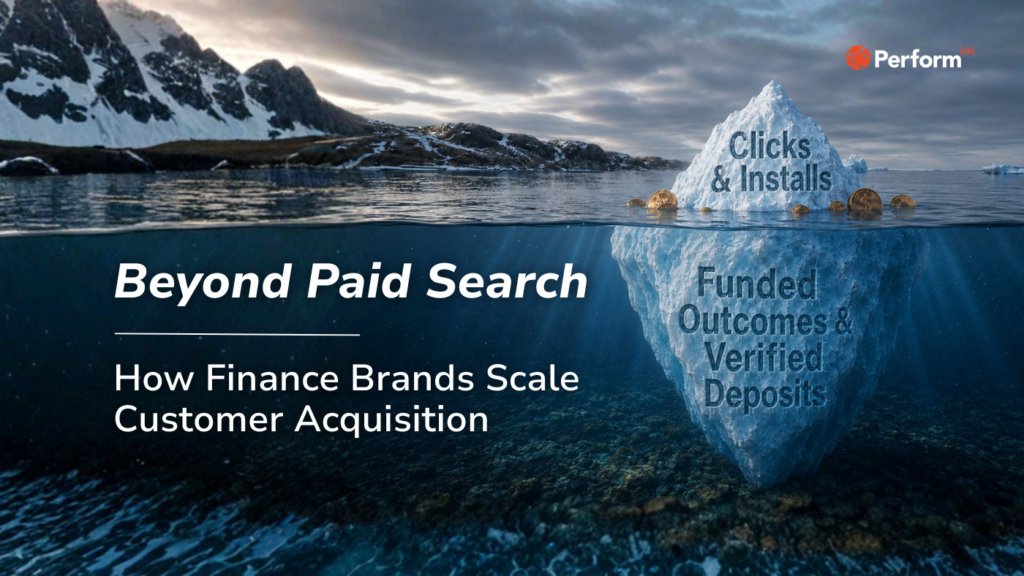
Table of Contents
Finance marketers don’t have a paid search problem. They have a qualification problem – and paid search is the most expensive place to discover it.
Google CPCs keep climbing. Meta keeps restricting financial targeting. Audience segments exhaust faster than they replenish. And the real damage shows up downstream: strong application volume, acceptable approval rates, funded account rates that don’t justify the spend.
Most finance brands respond by moving budgets around – Meta to search, search to display – looking for the channel that costs less. That’s the wrong problem to solve.
The brands growing funded account volume right now aren’t chasing cheaper clicks. They’re reaching financially qualified consumers before those consumers enter a comparison environment – before every lender, insurer, bank, and fintech is bidding on the same intent signal.
Paid search captures demand. It cannot create it. Building an acquisition system that does both is where scale actually comes from.
Table of Contents
- Quick Answer
- Why Finance Acquisition Breaks Down Before It Breaks the Budget
- What Finance Marketing Beyond Paid Search Actually Solves
- The Channel Question Finance Brands Are Asking Wrong
- Which Channels Earn Budget in Finance Acquisition Programs
- Why Finance Acquisition Technology Determines Whether Scaling Is Safe
- Reference Guide: What Is Outcome-Based Finance Acquisition?
- Decision Verdict
- Common Scenarios Where Pre-Search Finance Acquisition Wins
- Scaling Safely: Quality, Compliance, and Real Performance Outcomes
- Frequently Asked Questions About Finance Marketing Beyond Paid Search
- Build a Finance Acquisition System That Survives Channel Volatility
Quick Answer
Finance brands can scale customer acquisition without increasing paid search spend by using performance channels like native advertising, contextual placements, rewarded in-app traffic, keyword conquesting, card-linked offers, and CPE-optimized campaigns connected to verified downstream outcomes like funded accounts, approvals, and first deposits.
The strategic case is not just about cost. It is about reaching financially qualified consumers before they enter crowded comparison environments – before competitors have already shaped the decision.
| Strategy | Primary Benefit | Best Outcome |
| Paid Search | Captures existing intent | High conversion volume |
| Native Advertising | Reaches consumers during financial research | Lower CAC on qualified prospects |
| Contextual Placements | Aligns with relevant financial content environments | Better approval and funded rates |
| Rewarded In-App Traffic | Scales mobile acquisition efficiently | Lower CPA when optimized beyond install |
| Keyword Conquesting | Captures comparison-stage consumers | New-to-brand funded accounts |
| Card-Linked Offers | Connects acquisition to spending behavior | Redeemed offers and customer matchback |
| Performance Campaigns Optimized to Verified Outcomes | Shifts budget toward profitable acquisition sources | Stronger ROAS and funded account efficiency |
Paid search still matters. It just should not carry the whole media mix.
Why Finance Acquisition Breaks Down Before It Breaks the Budget
Paid search is not the first thing that breaks in a finance acquisition program. Usually, it is Meta.
Meta’s financial products and services special ad category requires marketers in the U.S., Canada, and certain European countries to use a special campaign designation that restricts age, gender, ZIP code targeting, exclusion targeting, lookalike audiences, saved audiences, and certain interest-based targeting options.
Finance campaigns depend on those signals. Income proxies, location patterns, life-stage indicators, behavioral intent, modeled lookalikes – these are what determine whether a consumer is likely to apply, qualify, fund, or activate.
When those signals disappear or become harder to use, efficiency erodes quickly.
A campaign that performs well at $50K per month can fall apart at $200K because the audience signals that made it work are no longer available at scale. That forces budget back into search, where every other finance brand facing the same Meta constraints is also piling in.
The result is a familiar but underdiagnosed squeeze:
- Meta restrictions reduce targeting precision as budgets scale
- Displaced spend floods into search, CPCs climb
- Search volume stays fixed while competition intensifies
- Acquisition teams keep raising bids on the same bottom-funnel terms
- CAC rises not because search stopped working, but because the whole acquisition system ran out of room
This is not a paid search problem. It is a channel dependency problem with a compliance constraint at the root.
The fix is not simply diversifying channels. It is building an acquisition system that does not collapse when any single channel hits a ceiling.
For a broader view of how performance-based acquisition supports channels already working, see Perform[cb]‘s CPA marketing guide for brands.
What Finance Marketing Beyond Paid Search Actually Solves
Most finance acquisition conversations start in the wrong place.
The question is usually: which channel is cheaper than search? That leads to bad decisions.
Native advertising is not cheaper than search. Contextual placements are not discount Meta. Rewarded in-app traffic is not a shortcut to funded accounts.
The right question is: where does acquisition quality break down, and can reaching consumers earlier fix it?
For most finance brands, quality breaks down at the lead-to-funded gap.
A campaign generates strong application volume. Approval rates look acceptable. But funded account rates, the metric that actually predicts revenue, come in well below expectation. The acquisition system is filling the top of the funnel with consumers who were never likely to complete.
That happens for a predictable reason. Bottom-funnel search captures consumers who are actively comparing options. In financial services, aggressive comparison behavior often signals a consumer who has already been declined elsewhere, is rate-shopping without intent to commit, or is evaluating products they do not qualify for.
Reaching consumers earlier tends to produce a different quality profile.
A consumer researching debt consolidation who encounters a personal loan offer is in a different mindset than a consumer searching “best personal loan rates.” One is forming a decision. The other is already deep in a comparison set where price and terms dominate.
Pre-search finance acquisition is not about being cheaper. It is about reaching consumers while qualification signals are still forming and before competitors have already shaped the comparison environment.
The Channel Question Finance Brands Are Asking Wrong
Most finance acquisition teams evaluate channels by cost per lead.
That is the wrong metric for the problem they are trying to solve.

The cheaper lead costs more per funded customer. But acquisition dashboards often never surface that distinction because the connection between traffic source and downstream outcome is not tracked.
That attribution gap is where finance acquisition programs hemorrhage budget.
The channel question worth asking is not “which channel is cheapest?” It is “which channel consistently produces consumers who fund, activate, and stay?”
When finance brands reframe the question that way, channel selection changes entirely. Native placements inside financial research content tend to produce consumers still in the evaluation phase: more open to education, less price-anchored, and less likely to have been declined by a competitor. That does not always mean cheaper leads. It means better ones.
Which Channels Earn Budget in Finance Acquisition Programs
Not every channel belongs in a finance acquisition plan. The right mix depends on the product, the qualification profile of the target consumer, and how tightly the campaign can connect early engagement to downstream funded outcomes.
Perform[cb]‘s Outcome Engine is built for exactly this evaluation: not which channel produces the most traffic, but which environments consistently generate consumers who complete. The goal is not to replace paid search. The goal is to build the acquisition layer that feeds qualified demand into the funnel and reduces dependence on bottom-funnel bidding wars.
Channel Fit by Finance Product and Acquisition Goal
| Channel | Where It Earns Budget in Finance | Watchout | Strongest Downstream Signal |
| Native Advertising | Lending research, investing education, credit improvement, insurance comparison content | Creative that feels like an ad destroys the contextual trust that makes native work | Funded accounts, approved applications, quote completions |
| Contextual Placements | Tax prep, budgeting tools, debt reduction content, personal finance publishers | “Finance” as a context is too broad; placement must match the specific product decision | Approval rate by content environment, funded loan efficiency |
| Rewarded In-App Traffic | Banking apps, savings platforms, credit monitoring, investing products | Optimizing toward installs produces low-quality users; optimize toward funded accounts, linked accounts, first deposits, or completed onboarding | Funded accounts, first deposits, activated users |
| Keyword Conquesting | Competitor comparison moments, adjacent product research, rate comparison queries | Compliance discipline is non-negotiable in financial services keyword conquesting | Conversion assist rate, new-to-brand funded rate |
| Card-Linked Offers | Local financial services, cash back products, spending-triggered financial offers | Works best for clear, simple consumer actions, not complex multi-step financial decisions | Redeemed offers, customer matchback to funded accounts |
| CPE-Optimized Campaigns | Multi-step finance funnels where early engagement predicts completion quality | Optimize toward meaningful downstream events, not cheap early actions like email submits | Verified application completions, approval rate by engagement cohort |
The channel table above shows what each environment is accountable to. Any channel that cannot be measured against those downstream signals does not belong in a performance acquisition program.
An insurance brand expanding beyond Meta might prioritize contextual placements first, targeting tax prep and financial planning content where consumers are already evaluating coverage gaps. A lending brand with declining approval rates might test native placements inside credit improvement content, where consumers are actively working to qualify rather than comparison-shopping rates. A fintech app scaling mobile acquisition might layer rewarded in-app traffic optimized toward first deposit, not install volume.
Choosing the right channel is only half the problem. Scaling it safely is the other half.
Why Finance Acquisition Infrastructure Matters More Than Traffic Volume
Alternative acquisition channels only deliver what paid search can’t if the infrastructure underneath them can actually identify quality – and cut waste before it compounds.
That’s harder than it sounds. Different publishers, traffic sources, creative formats, and placement environments don’t just produce different volumes. They produce fundamentally different consumers. One source generates cheap applications and a funded account rate that makes the whole channel unprofitable. Another generates fewer leads and significantly higher customer value. Most acquisition platforms can’t tell you which is which because they stop measuring at the click or install.
In financial services, that gap isn’t just an efficiency problem. A single bad traffic source can generate TCPA exposure, FCRA violations, or fraud liability that dwarfs the media spend it produced. The compliance risk scales with the volume. That means the infrastructure question isn’t optional – it’s the thing that determines whether growth is sustainable or whether it creates legal and operational exposure faster than it creates revenue.
Perform[cb]‘s Outcome Engine was built around this specific problem. Rather than reporting on what converted, it continuously evaluates which acquisition environments produce the strongest downstream outcomes – funded accounts, approved applications, first deposits, activated users – and shifts budget toward them automatically. Weak sources get filtered out as a natural consequence, not a manual cleanup task. The result is a campaign that gets more efficient as it scales, not less.
One personal finance brand – offering credit score reporting and identity theft protection – came to Perform[cb] with the same problem this blog describes: existing campaigns had reached a ceiling, and adding budget wasn’t moving the needle. Perform[cb]‘s Outcome Engine introduced new, incremental performance channels alongside the programs already running, onboarding vetted finance-vertical partners and running split tests across custom landing pages to identify which combinations drove qualified enrollments. SubID tracking connected every traffic source to downstream conversion quality.

The infrastructure made it possible. The channels were the opportunity.
Reference Guide: What Is Outcome-Based Finance Acquisition?
Outcome-based finance acquisition is a performance marketing model where marketers pay for verified business outcomes instead of media exposure alone. This is the finance-specific version of outcome-based customer acquisition, applied to funded accounts instead of clicks.
Rather than optimizing campaigns around clicks, impressions, or install volume, marketers optimize toward downstream actions tied directly to revenue generation, including funded accounts, approved borrowers, completed applications, deposits, linked accounts, quote completions, or activated users.
This model exists because finance conversion funnels are longer and more qualification-dependent than most verticals. The gap between a lead and a funded account can be enormous. Optimizing toward the wrong metric at the top of the funnel produces wasted spend at a scale most acquisition teams only discover after the damage is done.
| Component | Definition |
| Optimization Goal | Verified business outcomes |
| Common Pricing Models | CPA, CPL, CPE |
| Typical Traffic Sources | Native, contextual, rewarded in-app, keyword conquesting, card-linked offers |
| Primary Benefit | Lower acquisition risk and stronger funded account efficiency |
| Most Important Distinction | Optimizes toward revenue-predictive outcomes, not surface engagement |
The practical test is simple: if your acquisition program cannot tell you which traffic sources produce the highest funded account rates, it is optimizing for the wrong thing.
Pre-Search Finance Acquisition Checklist
| Question | Practical Answer |
| What consumer signal appears before search intent in finance? | In lending, it is credit improvement content and debt consolidation research. In insurance, it is life event content and financial planning. In investing, it is budgeting tools and tax prep resources. In banking, it is relocation, payroll, small business formation, and local market entry behavior. |
| Which channel reaches that signal efficiently? | Native and contextual placements work best when the consumer is researching. Rewarded in-app and CPE campaigns work better when the consumer is ready to act but has not yet entered comparison mode. Card-linked offers work when the desired action is simple and transaction-linked. |
| Which verified outcome proves the traffic is worth scaling? | Funded accounts, approved applications, first deposits, linked accounts, quote completions, and activated users matter more than leads or application starts alone. |
If a campaign cannot answer those questions, it is optimizing for volume instead of value.
Decision Verdict
For most finance brands, the strategic decision is not paid search versus alternative channels. It is how to build an acquisition system that does not break when Meta tightens restrictions, search CPCs spike, or a single channel hits a volume ceiling.
Most growth teams need both paid search and pre-search acquisition channels.
| Decision Category | Paid Search Wins When… | Pre-Search Wins When… | Best Overall Choice |
| Immediate lead volume | You need applications this week | You can build qualified demand over time | Paid Search |
| Funded account efficiency | Approval rates are strong and stable | Lead-to-funded gap is widening | Pre-Search |
| Channel resilience | Meta and search are both scaling profitably | Meta restrictions or search CPCs are limiting growth | Pre-Search |
| Audience reach | Core segments are not yet exhausted | Frequency is rising and incremental reach is shrinking | Pre-Search |
| Compliance control | Current channels meet all regulatory requirements | Targeting restrictions are limiting compliant scale | Pre-Search |
| Sustainable growth | Search still scales efficiently | You want more customers without overpaying for every click | Combined Approach |
The strongest move is building a system where paid search captures demand and pre-search acquisition creates more of it. Perform[cb]‘s Outcome Engine is designed around that idea: you pay when a customer is acquired, not when a click fires.
Common Scenarios Where Pre-Search Finance Acquisition Wins
The lead-to-funded gap is where too many finance acquisition programs get vague.
So let’s make it concrete.
Scenario 1: Lending Brand With a Lead Quality Problem
A personal loan marketer is hitting application volume targets. Funded account rates tell a different story.
The problem is who search is capturing: consumers already deep in comparison mode, many declined elsewhere, most price-anchored to the point where qualification is unlikely. The funnel looks full. The quality isn’t there.
Shifting acquisition earlier – native placements inside credit improvement and debt consolidation content – reaches consumers while they’re still building toward a decision. They haven’t been declined. They’re not comparing rates yet. The offer lands before the comparison set forms.
Funded account rates improve. Not because the offer changed. Because the consumer did.
Scenario 2: Fintech App Burning Through Audience Segments
A mobile investing app needs to double acquisition volume. Its best-performing segments are exhausted. Frequency is up. Incremental reach is shrinking. Adding budget to existing channels produces diminishing returns, not growth.
Rewarded in-app traffic opens mobile environments existing campaigns haven’t touched. The critical variable: campaigns optimize toward first deposit, not installs. An install is a download. A first deposit is a customer. Those aren’t the same thing – and optimizing for the wrong one is how mobile acquisition programs fail at scale. Burning through segments is often the first sign a finance app’s user acquisition partner has hit a ceiling.
Scenario 3: Insurance Brand Hitting Meta’s Special Ad Category Wall
Meta’s special ad category removes the signals that made insurance campaigns efficient: age, ZIP, lookalikes, demographic exclusions. The audience gets broader. The efficiency gets worse. Raising budget doesn’t fix it.
Contextual placements in financial planning, tax prep, and life event content reach consumers when insurance is already forming in their mind – without depending on the signals Meta restricts. The targeting logic shifts from who this person is to what decision this person is actively researching. That’s a more durable signal anyway.
Scenario 4: Banking Brand Entering a New Market Cold
A regional bank expanding into new markets has the same problem every new entrant has: search can only capture consumers who already know the bank exists. In a new market, that’s close to nobody.
Contextual placements, card-linked offers, and CPE campaigns optimized toward account-opening milestones build demand before the brand has earned search volume. For banks, pre-search acquisition isn’t a channel tactic. It’s how you build a market from scratch instead of waiting for one to find you.
Scaling Safely: Quality, Compliance, and Real Performance Outcomes
Finance acquisition can’t scale on volume alone. The vertical won’t allow it.
Financial services is one of the few categories where weak acquisition controls create legal liability, not just wasted spend. TCPA violations, FCRA exposure, state-level lending regulations, insurance licensing requirements, and fraud risk don’t just cost money – they create regulatory consequences that take quarters to unwind. A bad traffic source isn’t an efficiency problem. It’s a compliance problem with a long tail.
The brands scaling safely treat quality as architecture, not afterthought. Publisher vetting, fraud prevention, compliance oversight, traffic transparency, and downstream outcome tracking aren’t post-launch cleanup tasks. They are the acquisition system. You design them in before the first consumer sees the offer, or you spend the back half of the year cleaning up what the front half built.
The practical standard is simple: if you can’t trace a lead to a compliant publisher, attribute it to a verified downstream outcome, and confirm it was worth acquiring – you don’t have a performance program. You have volume with unknown liability attached to it.
The personal finance brand behind Perform[cb]‘s most cited finance result didn’t just highlight revenue growth as the outcome. They specifically cited compliance standards and traffic transparency as the reason the program could scale without risk. Quality and growth aren’t in tension when the acquisition system is built to enforce both.
Perform[cb]‘s finance acquisition programs are built to that standard. Every partner vetted. Every source traceable. Every outcome tied to the metric that actually predicts revenue.
Frequently Asked Questions About Finance Marketing Beyond Paid Search
What are the best alternatives to paid search for finance brands?
Native advertising, contextual placements, rewarded in-app traffic, keyword conquesting, card-linked offers, and CPE-optimized campaigns are among the strongest alternatives. The best programs map each channel to a specific finance product, qualification signal, and downstream outcome.
Why do finance brands face acquisition constraints that other verticals do not?
Financial products are more regulated, more qualification-dependent, and more restricted on major ad platforms. Beyond Meta’s special ad category, TCPA, FCRA, lending, and insurance requirements create compliance pressure that most verticals never encounter.
What makes outcome-based acquisition lower risk in financial services?
When campaigns optimize toward funded accounts, approved applications, deposits, and activated users, there is no incentive to chase cheap leads that inflate volume but never become customers. The acquisition program is accountable to the same outcomes that predict revenue.
Can finance brands still scale efficiently outside Google and Meta?
Yes. Finance brands can generate incremental funded account volume through native advertising, contextual placements, rewarded in-app traffic, CPE campaigns, card-linked offers, and other performance-based channels when those campaigns are tied to verified downstream events.
How should finance marketers measure pre-search acquisition?
The core metrics are funded accounts, approval rates, CAC by traffic source, first deposits, linked accounts, and activated users. Cost per lead and application volume are directional, not definitive.
Does pre-search acquisition lower CAC in financial services?
It can lower blended CAC when it reaches consumers before competition peaks. Judge it by funded account efficiency, not cost per application.
How does Perform[cb]’s Outcome Engine improve finance acquisition efficiency?
Most acquisition platforms optimize toward the event they can measure most easily – a click, an install, a form submit. Perform[cb]‘s Outcome Engine is built around the event that actually matters: a funded account, a first deposit, an approved application, an activated user.
The practical difference is significant. When campaigns optimize toward verified downstream outcomes, budget naturally concentrates in the environments producing real customers – not just the ones producing cheap top-of-funnel volume. Sources that inflate application counts without producing funded accounts get deprioritized automatically. Compliance-vetted publishers with proven downstream performance get more spend. The system gets more efficient as it gathers data, rather than requiring manual source management to stay that way.
For finance brands specifically, the Outcome Engine also handles the compliance layer that most performance platforms ignore entirely – publisher vetting, fraud filtering, and traffic transparency built into the program architecture, not bolted on after the fact.
The result: acquisition programs where every channel is accountable to the same metrics your finance team uses to evaluate growth.
Build a Finance Acquisition System That Survives Channel Volatility
The finance brands that keep growing built acquisition systems that don’t depend on any single channel staying affordable, compliant, or available. One CPC spike. One platform restriction. One policy change. That’s all it takes to break an acquisition program built around a single source of demand.
Perform[cb]‘s Outcome Engine is built for finance apps that need to scale without that exposure – every channel accountable to funded outcomes, every dollar traceable to the consumer who actually completed, growth that doesn’t require outbidding everyone else for the same bottom-funnel click.
If your current acquisition program can’t tell you which sources are producing your best funded accounts, it’s optimizing for the wrong thing.