Table of Contents
Resolutions are easy to download. Keeping them is the harder part.
Welcome to part two of our Q1 Ramp Series. After diving into finance apps in part one, we’re shifting our focus to health and wellness.
Every January, health and wellness apps get the biggest wave of new users of the year, and the wave that fades fastest before a free trial ends. Your Q1 plan is already built to catch it: budget set, creative ready, a paid mix that knows how to find people who want to move more, eat better, or sleep through the night.
What moves the needle in Q1 isn’t a bigger wave. It’s the channels that add users who are still showing up when the trial ends.
That’s the work worth doing in Q4: optimizing the channels already converting for you, and testing channels you aren’t running yet, so you start the year scaling instead of still vetting.
Quick answer
Scaling health and wellness app user acquisition in Q1 doesn’t mean rebuilding your plan. It means testing one or two incremental channels in Q4, with partners vetted for traffic quality before spend scales, and paying only when users complete the down-funnel event you care about most, like a trial start or a paid subscription. Verified Lift then shows whether those users were truly incremental in the MMP you already use.
| Building block | What it does for your Q1 plan |
| Native and content placements | Reaches people reading about workouts, nutrition, and sleep before they open the app store |
| Keyword conquesting | Ranks your app in app store search for competitor and category terms |
| NIL partnerships | Puts your app in front of athlete audiences who already follow a training routine |
| App Media | Reaches people inside the apps they already use, through partners with a track record in health and wellness |
| Fraud and traffic-quality safeguards | Reviewed and locked in during Q4, not audited in February |
| Verified Lift | Proof of incremental install lift, visible in your MMP |
| Partner-level optimization | Keeps spend on the partners producing paid subscribers, not installs that churn |
Why health and wellness app acquisition peaks in Q1
The January surge in health and fitness apps starts before January does, and it pulls in more than one kind of goal at once.
- Resolutions lead with health. In YouGov’s 2026 resolutions poll, exercising more was the top resolution at 25%, followed by being happy (23%), eating healthier (22%), and improving physical health (21%). That spreads demand across fitness, nutrition, sleep, and mindfulness apps, not just workout trackers.
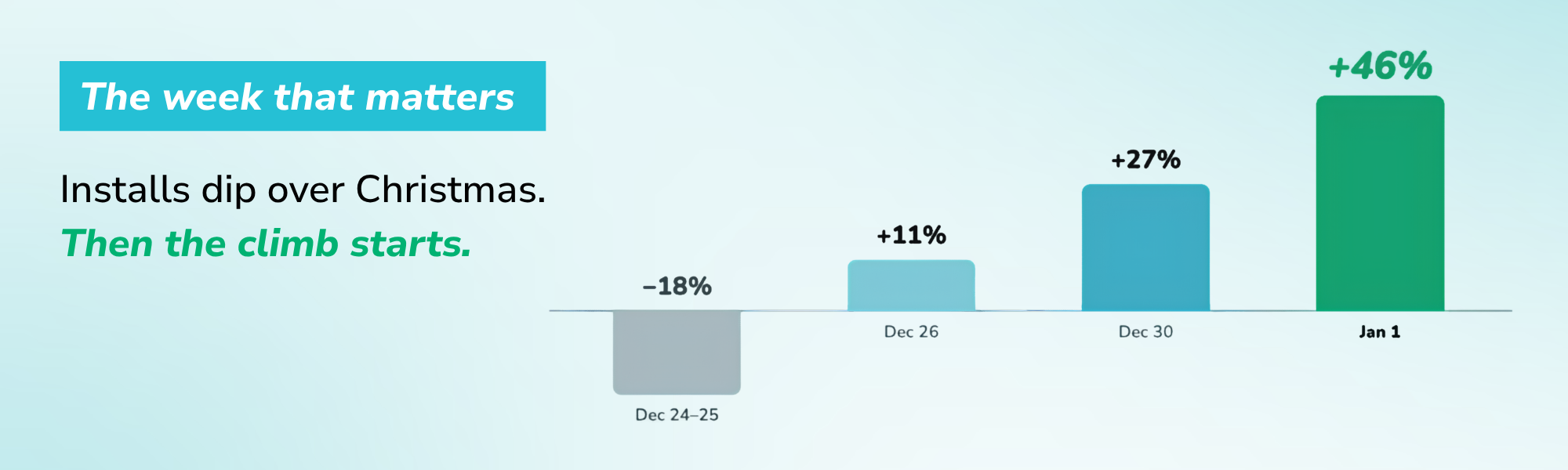
- Installs move the week after Christmas. In Adjust’s 2024 holiday data, health and fitness installs dipped over Christmas, climbed 11% by December 26 and 27% by December 30, then jumped 46% on New Year’s Day 2025.
- Subcategories spike harder. On New Year’s Day 2024, calorie tracker installs ran 159% above December’s daily average, and fitness tracker installs ran 71% above it.
- Competition peaks with it. Health and wellness brands take about 12% of all January ad spend, up from roughly 10.5% the rest of the year, according to Sensor Tower’s January 2025 and 2026 data. Every brand in the category goes after the same users in the same two weeks.
- The January cohort churns fastest. January users tend to have the lowest lifetime value of any monthly cohort because so many drop off early. A second, smaller wave arrives in Q2, so channels that hold up in January keep paying off from there.
What a realistic Q4 test window looks like
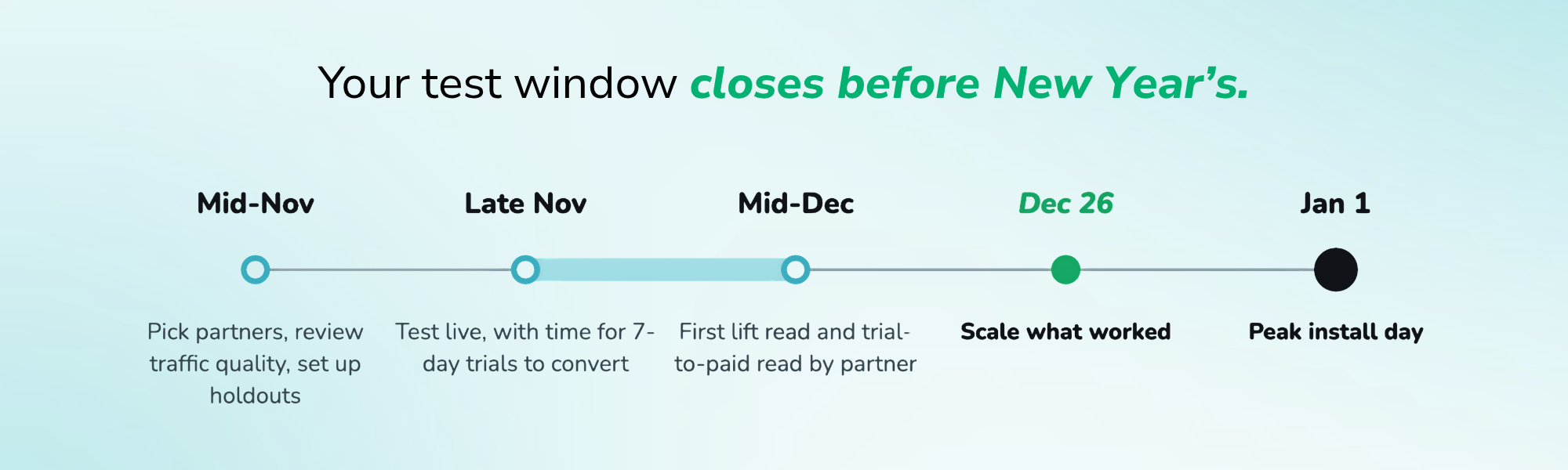
Starting in mid-November, the runway is shorter than it sounds. Health and fitness demand turns on December 26, not January 2, and free trials push the event you care about a week or more past the install.
- Mid-November: Pick partners, run the traffic-quality review, approve the offer and creative, and set up holdouts in your MMP.
- Late November through mid-December: Test live. Leave room for a 7-day trial to convert, plus slower approvals over the holidays.
- Mid-December: Get your first incrementality read, and your first trial-to-paid read by partner.
- December 26: Scale what worked, ahead of the New Year’s Day peak.
Q4 media gets crowded with holiday competition. Paying on trial starts or paid conversions keeps every test dollar tied to the users who matter.
The real cost of waiting to test a new channel
The real risk is walking into the New Year’s surge without evidence: no read on whether a new channel is incremental, and no sense of which partner’s users actually convert from trial to paid. Setting aside a small share of media spend for a new channel now is how you get that read.
Test a new channel on January 2, and you learn whether it works after the peak has already passed. In health and fitness, the window opens the week after Christmas, and the teams that tested, cleared, and verified a channel in Q4 spend that week scaling it.
There’s a second cost too. January brings the most installs of the year and the fastest drop-off, so a channel that looks efficient on installs can quietly fill your funnel with users who never start a trial. Testing in Q4 shows you which sources bring users who stay, before the volume makes it hard to tell.
The channels worth testing for Q1
You choose the channels. We hand-pick the partners inside them, based on which ones deliver quality users for your category and your KPI. These channels reach people your current mix misses, and you only pay when those users complete the event you care about most, like a trial start or a paid subscription, not an impression or an install. They’re worth keeping year-round, not just in January.
In health and wellness, that bench is already deep. The partners we place on fitness campaigns have run for apps like BetterMe, Breethe, and ClassPass, so your test starts from what’s worked in the category, not from zero.
| Channel | What it does | Why it adds net-new users in health and wellness |
| Native and content placements | Places your app inside articles and feeds about workouts, nutrition, sleep, and mental health | Reaches people researching a goal before they search the app store, where every competitor is bidding |
| Keyword conquesting | Ranks your app in app store search for competitor and category terms (workout plans, calorie counters, sleep apps) | Captures comparison intent at the moment of download, with an organic upside once your app ranks |
| NIL partnerships | Puts your app in front of a college athlete’s audience through a performance-based endorsement | Athletes’ followers already care about training and recovery, and they trust the person recommending the app |
| App Media | Places your app in front of people while they’re using other apps, through vetted in-app partners | Reaches people already active on mobile, and works best when it pays out on a trial start or first workout, not an install |
Keyword conquesting targets at least a top-3 ranking, often #1, and once your app ranks, some of that reach turns organic. To run it, your app needs AppsFlyer as its MMP.
Every channel here adds to the paid acquisition you already run. None of it replaces paid social, search, or the partners already working for you. It’s one more lever in the paid piece of your plan, reaching people while they’re still deciding which app to trust with their goal.
A January install that never starts a trial isn’t a customer. It’s a line item that looks efficient on New Year’s Day and funds nothing by February.
Verified Lift: How to prove incremental lift in your own MMP
In January, every brand in the category is advertising at once, and plenty of users would have found your app anyway. Every install you pay for should be one you wouldn’t have gotten without that spend. Verified Lift lets you check that yourself instead of taking a vendor’s word for it.
For campaigns running Verified Lift, Perform[cb] builds a matched holdout: real users from the same vertical and partner mix who see zero ads. Any conversion inside that holdout is misattribution, credit your MMP would have handed the campaign with no real influence on the outcome.
Your MMP tags the holdout as its own source, so you can open it and check the math anytime:

Here’s how that reads in practice. A fintech app saw its iOS campaign convert at 0.36% against a 0.04% holdout: 89% Install Lift, meaning nearly nine in ten installs were net-new. Android came in at 97%. Swap in a fitness or sleep app, and the math doesn’t change.
Verified Lift confirms the users were net-new. Partner-level optimization, covered below, makes sure they subscribe. For a side-by-side of holdouts, geo tests, and walled-garden lift studies, see our guide to running an incrementality test.
How is keyword conquesting different from Apple Search Ads?
Apple Search Ads buys a paid placement above the results for a keyword. Keyword conquesting works on where your app ranks within the results, for competitor and category terms rather than your brand terms.
The real worry is paying twice for the same user. If keyword conquesting only claims users your Apple Search Ads or organic would have delivered anyway, the holdout converts at nearly the same rate as the campaign, and Install Lift drops toward zero in your MMP. Results break out by channel and partner, so an overlapping source shows up as a number you act on.
Fraud prevention and traffic-quality safeguards for a health and wellness Q1
Fraud prevention isn’t a footnote in a January plan. When installs spike, bad traffic hides inside the volume, and it scales right along with the program. Quality standards for the users you pay for get locked in during Q4, not audited in February.
Perform[cb] uses a layered approach to monitor and prevent fraud, combining internal data analysis with third-party fraud detection tools.
We review:
- Perform[cb] platform data: conversion patterns, click-to-conversion timing, geo and device consistency, and abnormal traffic spikes.
- Marketer-side data: sign-up quality, trial conversion rates, duplicate or fake sign-ups, and attribution discrepancies.
- Click-level data: IP quality, repeat clicks, proxy and VPN usage, user-agent validation, and unusual behavior patterns.
Fraud types we monitor:
- Bot and non-human traffic
- Click flooding and click injection
- Proxy and VPN traffic
- Device or domain spoofing
- Duplicate or fake sign-ups
- Geo-mismatch and suspicious traffic patterns
We pair our in-house fraud detection with independent third-party verification tools, so every source is monitored and validated continuously. The goal is simple: every user you pay for meets your quality standards and stays compliant.
That review applies to every channel in the mix, App Media and NIL included, and it happens before the channel scales.
How spend stays tied to paid subscribers
An install isn’t a customer. A free trial is a start, but the number that matters is whether that user converts to paid, and most acquisition programs can’t see that by source.
We track every partner against verified down-funnel events like trial starts, first workouts logged, and trial-to-paid conversions. Within each channel you run, we find the partners delivering users who convert and shift spend toward them. That’s the difference between a source that looks great on January 1 and one still producing subscribers in March.
| Mini Q&A | |
| What do you track? | Real outcomes like trial starts and paid conversions, not clicks or installs |
| Does this change which channels we run? | No. You choose the channels. Within each one, we find the partners delivering the highest-quality users and shift more spend to them |
| How often does spend reallocate? | As outcome data comes in from live campaigns |
| Who sees the results? | You see down-funnel events by partner source in your own MMP, not just in a report we hand you |
The team behind a health and wellness Q1 plan
The right channels only scale with people who know the category and the calendar. The holiday dip, the December 26 turn, and the New Year’s Day spike show up every year. Reading them in real time, partner by partner, takes experience.
Perform[cb] was founded in 2002, which makes Q1 2027 our 25th first quarter. The people running tests alongside your plan have seen January volume flatter a channel before, and they know what to watch instead.
That experience shows up in the details. Your dedicated growth manager knows which partners clear traffic review on the first pass, which ones send users who finish a free trial, and where budget should sit on December 26. They also know which channels need a longer read, because trial-to-paid events land a week or more after the install.
A common scenario where testing a new channel pays off
A well-known personal fitness app wanted more new users without letting its cost per free trial creep up. Perform[cb] launched a CPA campaign on trial activations, then layered a CPI campaign on top, using in-app display partners with a track record on other fitness and wellness apps.
In the first 45 days, the program drove 2,000+ free trials, lifted trials 19% once the CPI campaign was layered in, and brought the average cost per free trial to $7.

Reference guide: How to set up health and wellness app acquisition for a strong 2027
Setting up for a strong 2027 means giving a plan that already works more room to scale, not building a new one from scratch. Pick channels with early results, work with partners that have cleared traffic review, and set up lift testing in Q4 so you’re ready for the week after Christmas.
This matters because the category’s biggest wave of users is also its fastest to churn. A channel judged on installs alone will look its best in January and its worst by March.
| Element | Why it matters |
| Channel selection based on evidence | Keeps budget out of channels that look efficient on installs but aren’t incremental |
| Traffic-quality review before scale | Keeps bad traffic from hiding inside January volume |
| Incrementality testing | Confirms results in your own data before the budget moves |
| Judging partners on trial-to-paid | Ties spend to subscribers, not to resolutions that fade |
Teams adopt this approach when current channels plateau, when a new feature or subscription tier launches into Q1, or when last January’s cohort churned faster than planned. The strongest teams use last year’s Q1 results and current channel-level incrementality data to decide what to test in Q4.
Frequently asked questions about Q1 health and wellness app acquisition
Do health and fitness apps need to overhaul their acquisition plan to test new channels?
No. Native and content placements, keyword conquesting, NIL partnerships, and App Media are built to run alongside your existing paid mix, not replace it. Perform[cb] works as one part of your broader paid strategy, adding scale on top of what’s already working.
What makes an acquisition channel incremental instead of just additional volume?
An incremental channel produces conversions that would not have happened through your existing channels. In January, when organic downloads spike on their own, that difference matters more than any other month.
Verified Lift separates the two with a matched holdout of real users who see no ads. If the holdout converts at nearly the same rate as the live campaign, the channel adds nothing. If the campaign converts far higher, the gap is real growth, broken out by channel and partner.
Will keyword conquesting overlap with our Apple Search Ads?
Not in the way most teams expect. Apple Search Ads buys a placement above the results. Keyword conquesting works on where your app ranks within them, for competitor and category terms rather than your brand terms. Verified Lift then measures any remaining overlap, so an overlapping source shows Install Lift near zero in your MMP and you can cut it with evidence.
When should health and fitness apps start testing for Q1?
By mid-November. Health and fitness installs start climbing on December 26, and a 7-day free trial means the event you care about lands a week or more after the install. Starting now leaves time for traffic review, holdouts, and a first read before the surge.
A test started on January 2 starts from zero after the biggest days of the year have already passed.
How do you keep January users from churning?
Retention starts with who you acquire. Tracking every partner against trial-to-paid conversions shows which sources bring users who stay, and shifting spend toward them improves the January cohort before it ever reaches your onboarding flow.
How is Perform[cb] different from vendors paid on clicks or installs?
Many acquisition vendors get paid on activity: clicks or installs that may never become subscribers. Perform[cb] ties spend to verified down-funnel events like trial starts and paid conversions, and shifts budget toward the partners producing them. Our team works inside the channels you choose, so you get judgment, not just a tool.
Make the resolution stick
Your Q1 2027 health and wellness plan doesn’t need to be rebuilt in December. It needs more room to scale before the week after Christmas: one or two channels you aren’t running yet, tested and verified while there’s still time.
Verified Lift proves the new users are incremental, and partner-level optimization keeps each dollar tied to users who convert to paid. Behind it is a team that has run this quarter 24 times before. That’s how teams head into 2027 with results they can plan around.
If your Q1 plan can’t yet show which channel will produce your next wave of paying subscribers, that’s the test worth running now.