![Perform[cb] Logo](https://www.performcb.com/wp-content/themes/performcb/assets/images/pcb_logo_full.svg)
![Perform[cb] Logo](https://www.performcb.com/wp-content/themes/performcb/assets/images/pcb_logo_mark.svg)


![Perform[cb] Logo](https://www.performcb.com/wp-content/themes/performcb/assets/images/logo.svg)

Table of Contents
Q1 is the Super Bowl for debt management. As the confetti settles on the New Year, millions of consumers wake up to a “financial hangover,” facing the reality of holiday overspending, rising credit card balances, and vowing that this is the year they finally get their finances under control.
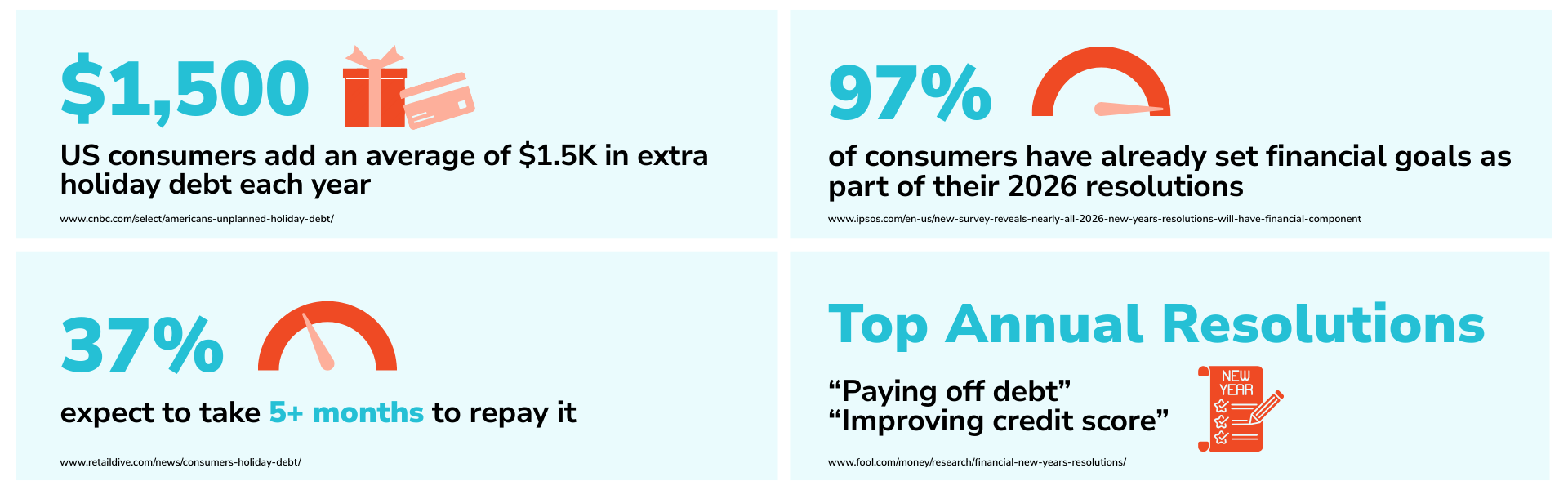
But between the CFPB enforcing new data rights rules and over 15 U.S. states enacting privacy laws similar to GDPR/CCPA, the regulatory landscape is tightening, and personal finance brands are feeling the effects. Simultaneously, Meta and Google are cracking down on targeting categories related to credit and financial distress.
By testing on the right outcome-based channels, you don’t have to rely on third-party data or worry about privacy hurdles to acquire high-quality users.
Why Compliance Actually Improves User Quality
Many marketers view privacy regulations as a hindrance, but they are actually a massive advantage for lead quality. Compliance naturally shifts the focus away from invasive personal data and toward performance.
When you embrace strict privacy and disclosure requirements, such as upfront fees and realistic timelines, you automatically filter out low-intent users. While hidden terms might generate quick volume, these leads rarely enroll. Conversely, when a user clearly understands the offer before they click or install, the ad copy itself acts as a pre-qualifier and improves down-funnel conversion.
Transparency filters out the noise early, saving you time, energy, and budget.
Finding Audiences Without Relying on Tracking
With third-party cookies crumbling, retargeting debt-distressed consumers on major platforms can flag privacy violations. Google Ads explicitly prohibits personalized advertising based on financial distress, and Meta has removed detailed targeting for sensitive financial topics.
To keep the funnel full without crossing any lines, the solution is a combination of contextual intelligence and native advertising. Together, they place your message in environments outside of the walled gardens where intent is naturally strong.
Contextual Intelligence
Instead of chasing the individual, focus on the content they’re actively consuming. Contextual targeting allows you to place ads on channels where financial conversations and research are already happening, such as personal finance blogs, budgeting guides, debt-management articles, and “how to improve your credit score” videos.
Native Advertising
Debt is a sensitive topic. Consumers respond better when ads match the tone, look, and feel of the surrounding content. Native placements feel less intrusive and establish trust, generating 25% higher engagement than banner ads for financial marketers.
Contextual intelligence finds the right moment, native placements deliver the right message, and an outcome-based model ensures you’re only paying when those users actually convert. This combination lets you reach motivated users, improve engagement quality, and drive more efficient conversions.
Mastering the Value Exchange with Zero-Party Data
You can still get compliant data – you just have to ask for it rather than taking it. Zero-party data is information a user voluntarily shares with you – on purpose, in context, and with clear consent. In a high-scrutiny vertical like personal finance, that’s the gold.
The best vehicle for collecting this data is interactive content, such as “When will I be debt-free?” calculators and “Do you qualify for debt consolidation?” quizzes. Additionally, the “Give to Get” model, where users willingly provide sensitive data (income, debt load, credit tier) if they get immediate value in return, such as a customized plan, a score, or a PDF guide.
Why this wins on every front:
- Trustworthy Compliance: 100% opt-in, transparent, and fully compliant. Users willingly provide their information, creating a clean, regulation-friendly data set for ongoing optimization.
- Higher Lead Quality: Interactive tools create 40% higher lead quality because a user who takes two minutes to fill out a calculator is infinitely more valuable than a user who accidentally clicks a banner.
- Accelerated Pipeline: Interactive tools pre-qualify users before they even hit your CRM. This leads to higher conversion rates, easier down-funnel optimization, and significantly stronger LTV.
- Outcome-Based Efficiency: An outcome-based model ensures brands only pay for the qualified users who actually engage with the tool, reducing waste and increasing ROI.
- Smoother Optimization: When your top-of-funnel traffic is already highly qualified, optimizing toward deeper actions – applications, approvals, funded accounts – becomes dramatically easier and more efficient.
Quality Over Quantity: Optimizing for Down-Funnel Events
To protect performance, you must shift focus from volume to qualified, verifiable outcomes, diversifying beyond the cost-per-lead (CPL) model.
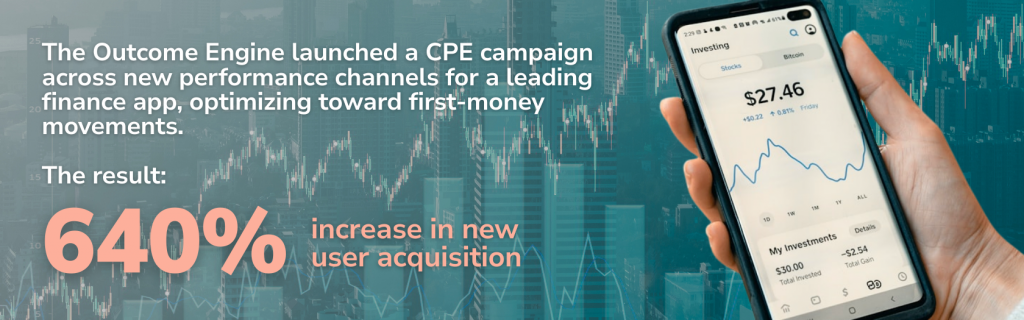
While CPL has a place in the media mix, relying on it solely means paying for form fills regardless of quality. Instead, consider testing cost-per-engagement (CPE) models that pay for actions proving real intent, such as a connected bank account, a completed credit consultation, or an uploaded verification document.
By layering performance models, you improve traffic quality, optimize spend across multiple touchpoints, and gain clearer insights into which channels deliver the most qualified users.
How the Outcome Engine Powers Privacy-Safe, High-Intent Growth
In personal finance, brand safety and compliance aren’t optional – they’re essential. Perform[cb] delivers unmatched protection through 24/7 compliance monitoring, always-on fraud prevention, and rigorous partner audits, ensuring every conversion meets the strictest industry standards.
One top personal finance app credited the Outcome Engine’s disciplined compliance approach, clear communication, and high-quality traffic for a dramatic transformation in performance. By activating new channels while safeguarding campaign integrity, the brand achieved a remarkable 1,214% surge in conversions.

At the core of this success is the Outcome Engine’s ability to identify and target users based on their likelihood to convert within specific placements. By ingesting and applying down-funnel metrics, the Outcome Engine builds a uniquely tailored campaign structure for you. This ensures ongoing optimization toward the channels that generate the most qualified events and align directly with each brand’s primary KPIs.
Turn Regulatory Hurdles into Competitive Gaps
Privacy regulations are scaring your competitors away from testing new channels. This creates a massive opportunity for brands willing to adapt.
Ready to scale your personal finance campaigns without the compliance headaches? Learn how Perform[cb] ‘s Outcome Engine can help you build an outcome-based model and expand into new channels while maximizing what’s already working.