![Perform[cb] Logo](https://www.performcb.com/wp-content/themes/performcb/assets/images/pcb_logo_full.svg)
![Perform[cb] Logo](https://www.performcb.com/wp-content/themes/performcb/assets/images/pcb_logo_mark.svg)


![Perform[cb] Logo](https://www.performcb.com/wp-content/themes/performcb/assets/images/logo.svg)
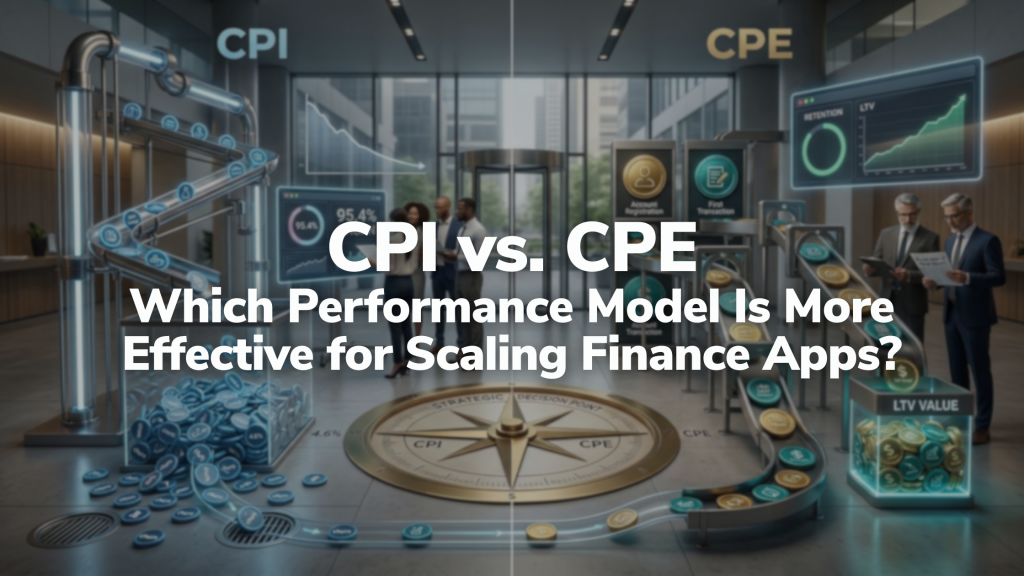
Table of Contents
Finance apps operate in one of the most regulated and closely scrutinized environments in performance marketing. In the first half of 2025 alone, digital regulatory fines were up by 417% year-over-year.
For performance marketers, this creates a difficult balancing act. You’re under pressure to scale. You’re expected to hit aggressive growth goals. But you’re also navigating stricter compliance requirements and justifying spend across your media channels. In this environment, the “fastest” scaling campaign isn’t always the safest – or most sustainable.
As retention challenges deepen and LTV becomes harder to protect, traditional install-led strategies are being re-evaluated. The question is no longer just – how to acquire users – it’s how to acquire the right users. So, is Cost Per Install (CPI) alone the right performance model for scaling finance apps? Or does Cost Per Engagement (CPE) offer a more durable outcome-based path forward? Maybe campaigns built for each – best of both worlds?
CPI Campaigns: Why “Cheap” Installs are Getting Expensive
CPI has long been the go-to model for top-of-funnel growth. It’s straightforward, measurable, and optimized for quick volume.
But beneath the surface, the math is getting harder to justify.
For the finance industry, only about 4.6% of new users continue engaging within the app 30 days after they install. That means if you’re driving traffic to UA campaigns purely looking to scale installs, you’re effectively paying for the 95% of users who churn within the first month. What looks inexpensive at the install level becomes costly at the revenue level.
This doesn’t mean CPI is obsolete. It’s still vital for growth. The trick is being more strategic about how that model is built. By adding a CPE layer, you’re double-filtering your traffic to ensure installs translate into qualified outcomes. You get the volume you need to scale, but with the added peace of mind that you’re only paying for the most high-intent users.

CPI still has its place, especially in regions and industries where costs have softened. But even a well-optimized CPI strategy relies heavily on assumptions about user quality, and assumptions are expensive.
CPE Campaigns: Prioritizing Intent in a Compliance-Heavy Environment
As Perform[cb]’s Chief Revenue Officer, Lee Aho, noted in an interview with Business of Apps, the era of optimizing for installs alone is effectively over. Sustainable growth depends on down-funnel signals that reflect real user intent. By shifting the performance model from installs to meaningful actions, such as account registration, a first transaction, or a deposit, marketers ensure they’re investing in long-term value.
Because finance apps often require multi-step onboarding processes, CPE naturally filters out users who are unwilling or unable to complete those steps. That kind of filtering is a lifesaver when you consider that global day-one retention for finance apps has dropped to roughly 12.5%. You can’t afford to waste your budget on low-intent installs.
CPI vs. CPE: A Strategic Comparison
Rather than asking which performance model is “better,” you should ask yourself how each model is designed to optimize your UA campaigns.
CPI Strengths
- Faster volume generation
- Lower upfront cost
- Effective for awareness and early funnel testing
CPE Strengths
- Higher-intent users → Stronger retention and LTV signals
- Better alignment with regulated conversion points
- Greater resilience against fraud and incentive abuse
The Tradeoff
- CPI optimizes for speed
- CPE optimizes for sustainability
The most effective strategy is often a hybrid approach. Use CPI for early funnel testing and awareness, then transition to CPE to secure long-term, sustainable growth.
Scaling Finance Apps Requires an Outcome-Based UA Partner
In 2026, scaling a finance app isn’t about buying the most installs. It’s about acquiring the most eligible users. The industry is shifting toward models that reward outcomes. Marketers who fail to adopt this sustainability-first mindset risk paying for short-term growth.
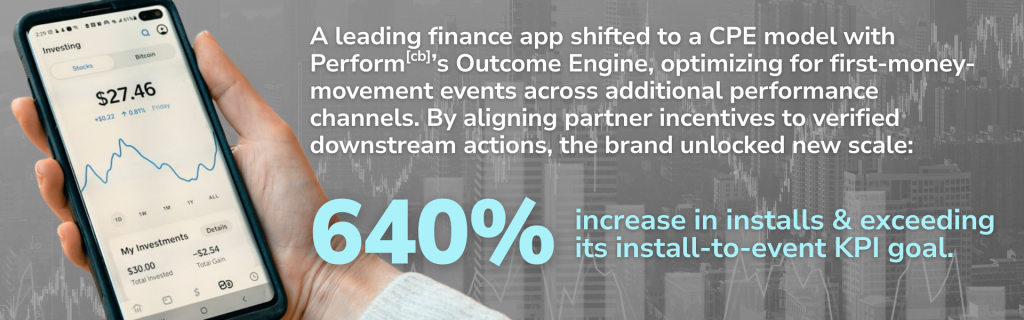
Perform[cb]’s Outcome Engine drives performance-based user acquisition for hundreds of finance apps, providing visibility into high-intent audiences, placements, and partners. By layering new performance channels alongside what you’re already running, you’re not disrupting what works – you’re adding a proven path to incremental scale that you haven’t tapped into yet. It’s scaling without the growing pains.
Learn how Perform[cb] can help you scale your finance app and validate a new growth channel.